
Tocopherols are among the most widely used natural antioxidants in the food industry. Their capacity to protect unsaturated lipids from oxidative degradation is well established, but their mechanism of action goes beyond simple radical scavenging. In food systems (bulk oils, emulsions, spreads), their effectiveness also depends on their physical behavior and their interactions with surrounding molecules. Understanding these factors is key to designing antioxidant strategies that actually work in complex formulations.
Vitamin E Molecular Structure and Tocopherol Chemical Formula in Antioxidant Function
Tocopherols belong to the vitamin E family. They are lipid-soluble compounds found naturally in plant seeds and vegetable oils. Tocopherols chemical formula shares a common structure: a phenolic chromanol ring attached to a saturated phytyl tail. The four homologues (α, β, γ, and δ-tocopherol) differ only in the number of methyl groups on the chromanol ring (Figure 1). This structural difference directly influences how readily each homologue donates a hydrogen atom to a free radical, the core mechanism of their antioxidant activity. Based on this chemical criterion, the order of reactivity is α > β = γ > δ
.
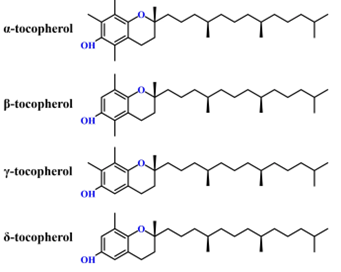
Figure 1. Chemical structures of α-, β-, γ-, and δ-tocopherols. Source: Liu Y et al. Analytical Strategies for Tocopherols in Vegetable Oils: Advances in Extraction and Detection. Pharmaceuticals (Basel). 2025 Jul 30;18(8):1137.
Natural tocopherols are characterized by RRR stereochemistry on the three asymmetric carbon atoms of the phytyl chain connected to the chromanol ring. Synthetic forms, by contrast, consist of a mixture of all eight possible stereoisomers, only one of which corresponds to the natural configuration. This stereochemical difference is relevant when considering both biological activity and labeling requirements in food applications. Natural α-tocopherol (RRR-α-tocopherol) is considered the most biologically active form.
In practice, however, their order of reactivity does not always predict their molecular activity in food systems. Concentration, temperature, the nature of the lipid substrate, and the physical structure of the matrix all influence which homologue will be most effective in a given application.
Molecular Basis of Action: Radical Scavenging and Molecular Inhibition in Lipid Oxidation
The primary way tocopherols protect lipids is by interrupting the radical chain reaction of autoxidation. They donate a hydrogen atom to lipid peroxyl radicals, neutralizing them and generating a stable tocopheroxyl radical that does not propagate further oxidation.
But the hydrogen donation mechanism is not the only one. Tocopherols can quench singlet oxygen, a reactive form of oxygen involved in photooxidation, primarily by physical deactivation, which dissipates energy without consuming the tocopherol molecule. They also show some capacity to chelate transition metals such as iron and copper, which would otherwise catalyze the breakdown of lipid hydroperoxides into new radical species.
One important practical consideration is the effect of concentration. At high doses, the oxidized form of tocopherol (TocO•) can participate in side reactions that actually promote oxidation rather than prevent it. This means that more is not always better: tocopherol concentration needs to be optimized for each system.
Performance can be substantially improved through synergistic combinations. Ascorbic acid, for example, can regenerate active tocopherol from its oxidized form, extending its protective lifetime. Metal chelators such as citric acid reduce the availability of prooxidant ions, limiting the oxidative initiation events that tocopherols would otherwise need to counteract.
This is why well-designed antioxidant systems combining natural tocopherols with complementary co-ingredients can outperform single-ingredient solutions. Btsa’s Tocobiol Blends® range is specifically designed around this principle, combining natural tocopherols with synergistic co-ingredients, including ascorbyl palmitate, rosemary extract, and lecithin, to deliver tailored antioxidant protection across a wide range of food applications.
Molecular Activity in Complex Food Systems: Bulk Oils, Emulsions, and the Polar Paradox
The physical structure of the food matrix is just as important as the chemistry. A key concept for understanding antioxidant behavior across different lipid systems is the polar paradox theory: polar antioxidants tend to be more effective in bulk oils, while nonpolar antioxidants perform better in oil-in-water emulsions.
In bulk oils, oxidation is most active at the oil-air interface and within microscopic structures formed by minor surface-active components. Polar antioxidants concentrate at these interfaces, positioning them exactly where oxidative reactions occur. Nonpolar antioxidants, dissolved in the lipid phase, are less well positioned to intercept free radicals at these sites.
In oil-in-water emulsions, the picture reverses. Oxidation is driven by the interaction between prooxidant metals from the aqueous phase and lipid substrates at the oil-water interface. Nonpolar antioxidants accumulate at this interface, protecting the lipid droplets from the outside. Polar antioxidants partition into the aqueous phase, away from where oxidation is actually happening.
Tocopherols are lipophilic and reside primarily within the oil phase. Their exact location relative to the oil-water interface, their mobility within the system, and their interactions with emulsifiers and phospholipids all influence how well they can protect the lipid substrate. Depending on the type of surfactant present, tocopherols may be drawn toward the interface or remain trapped in the oil core.
This means that choosing the right tocopherol for a given application is not straightforward. The homologue, its concentration, the emulsion type, the presence of co-ingredients, and the interfacial composition all interact to determine the final antioxidant outcome. This complexity is precisely why formulation expertise matters when developing natural antioxidant systems for real food products.
Btsa’s team of specialists can help you identify the most suitable natural antioxidant for your specific product and matrix. Contact us to find out how we can support your formulation needs.